Tuesday, April 24, 2007

Fight for the Colors: Ohio Battle Flag Collection


This online exhibit, sponsored by the Ohio Historical Society, makes available a popular exhibit from the organization's physical site.

I enjoy the layout of the pages. I like the colors and the "old-timey" feel. I was excited to look through the collection, until I started getting broken links. I visited the "online relic room" and was not able to view the Mexican War flags.

Collection Principles
The online collection is a representation of a physical exhibit. The society is not only interested in the physical artifacts but also texts and visual representations of the flags.

Object Characteristics

I was never able to view any of the flags, which was disappointing, but there were other images on the pages, thumbnails of what I may have seen if the links all worked. I couldn't really get a lot of information from those.

Metadata
One place the site excels is with the metadata. There is a page devoted to the description of the digitization process. The broad initiative is to digitize a number of artifacts from different kinds of collections. This collection is one of the most used, so digitization is for preservation and access purposes. The page discusses the technical specs including type of scanner used.

Audience
The audience could include a number of people. Those that have visited the physical collection and would like to see it again, researchers, historians, proud Buckeyes, and school groups are all among potential users.


ASIFA- Hollywood Animation Archive


The Hollywood branch of ASIFA, the International Animated Film Society, is creating an Animation Archive online. Their blog about the project, along with many digitized items spanning images, audio and video can be found on Blogger. At first I thought that the blog was the archive- which would be extremely weird. Why put the archive on Blogger when ASIFA-Hollywood has a website? I had to dig pretty far into the blog entries to discover that the blog is not the archive, just a temporary way of providing access to materials they have digitized while they continue to build financial support for the project. The range of material that will be part of the Animation Archive is very broad. In addition to cartoons, there are illustrations from books and magazines, old drawing manuals, pinup calendars, oral histories and more. Obviously, much (if not most) of the digitized material is not in the public domain. ASIFA is putting it up anyway and invoking fair use. In the terms of use section, users are specifically prohibited from putting Animation Archive cartoons on YouTube et al., although I have to wonder how easy it is to enforce that.

The quality of all of the digital objects on this site seems impeccable but no technical specs are provided. There is a link to ASIFA's page on Film Preservation, which affirms their mission to preserve all their cartoons as high-quality 35mm prints on safety film, a noble but expensive goal. I also spotted something that said they're doing their transfers to film using the equipment at UCLA's Film and Television Archive. The cartoons I watched on this site were far,far better looking than any I've seen on the Internet Archive. As far as metadata is concerned...there's virtually none. They are building an animation database which will contain "biographies of artists, filmographic info and media files." Currently it is possible to look for digital objects with a simple Google search within the blog, just using keywords. Steve Worth, creator of the archive, is described on Wikipedia as an animation producer and historian. It seems to me that his foremost concern is providing access and he is not as worried about nerdy things like metadata and data migration as someone in the library or archival professions would be. This may turn out to be fine as far as the Animation Archive is concerned, only time will tell.

Even the drawing-impaired like myself can find a lot to look at in this blog/archive. The illustration above is from a book of fairytales that was owned by a friend of my parents', which I loved to look at when I was a child. I had forgotten all about it and it was so sweet to rediscover it in the Animation Archive. The primary audience for the Archive, however, will be professional and student animators and serious collectors, i.e. people who are really passionate about preserving the art of hand-drawn animation.

Tuesday, April 17, 2007

Child Under Tree - The Virginia Landscape - Virginia Historical Society


Virginia is such a lovely place. I'm sure that this time of year it is especially beautiful. This online exhibit, featuring, among many others, the painting shown to the left, Child Under Tree - The Virginia Landscape - Virginia Historical Society, suggests a peaceful and happy time. It can't dim the horror of what happened in Blacksburg yesterday, however.

The Virginia Historical Society has digitized a portion of a collection of landscape paintings that were exhibited in 2000, mounted them in a simple, "one-after-the-other" format, carefully described each one with an emphasis on information about the artists (on a separate screen one clicks through to from the exhibit main page), and loaded each image up with so much rights information that it was astonishing to read through. It would be very interesting to see some figures on the revenue that this project brings in. One would think there must be a very high demand for reproductions of these images, based on the elaborate rights policies and procedures for requesting permission to use or order reprints, etc. Corbis has nothing on this Historical Society.

The original exhibit consisted of 240 paintings and drawings. The online exhibit shows just 12 of them. There is no explanation for why these were chosen. There is no metadata concerning the digitization process. The images are thumbnails that expand to slightly larger versions when one clicks on them. The audience is, I suppose, the general public.

The Power of Advertising: Burma-Shave


This online exhibit, from the William F. Eisner Museum of Advertising and Design in Milwaukee, Wisconsin, focuses on the famous Burma-Shave ad campaign of the 1920s and 30s. The company used series of road signs painted with rhyming limericks to catch the attention of motorists. Each series of signs ended with the words "Burma-Shave." This ad campaign elevated the company from near obscurity to the #2 brushless shaving cream in the country.

I find the museum's website atrocious. For a museum focused on design, one would think that good design would matter, but it seems like the site is concerned with aesthetics only and not usability. One of the most frustrating features of the site is the lack of an overall navigation bar. Once you click to a page, you have to use the back button to get back to where you were and there is no way to navigate easily through sections.

There also doesn't appear to be a direct link to the exhibit itself. Only to the page listing all of the museum's current online exhibits.

Collection Principles
Kitsch seems to be the overwhelming theme here. As it doesn't appear to have much if any scholarly value, the principles guiding the collection don't seem to be that strict. It seems that the exhibit uses whatever information it has available.

Object Characteristics
The site opens in a tiny window from the link on the exhibit page. There is an animated introduction that seems like it should include music, but it doesn't. This flashy info provides a dramatic intro to the Burma-Shave phenomenon while in the left vertical bar, text from the different signs appears. After the introduction, the user has three pages to choose from. The first is a text description of the history of Burma-Shave, the second is a collection of audio and video, and the third is a collection of images. The audio is actors reading the old Burma-Shave ads and is frankly a bit disturbing. I don't see much value in this section of the exhibit. The video links open the tiniest boxes I have ever seen and feel a lot like a VH1 behind the music. There are some still images intertwined with interviews and some reenactments of people using Burma-Shave or coming up with great ideas about how to market Burma-Shave. The image section is rather standard. The images are of course small and can't be resized.

Metadata
There isn't a lot of metadata associated with the site. The images are captioned with a year and what the item is. The audio section explains who the speakers are. The video section doesn't have a lot of information. The interviewees' names are superimposed on the screen, but there is no information about the reenactments.

Audience
As previously mentioned, this is not an academic resource. It is a light exhibit created for the general public. I see it as a way for people to reminisce about their experiences with the campaign and enthrall younger generations with the wonder of the red signs.

UNT Music Library Virtual Rare Book Room

Just like the previous post, this is a University of North Texas digitization project. The Music Library Virtual Rare Book Room contains scanned images of over a hundred bound-format musical scores, mostly from the 18th c. The digital library includes some materials that were borrowed from private collectors and scanned with their permission. They plan on adding materials to the collection and there is contact information for the Music Librarian at UNT so that website users can suggest items for future inclusion.

The scores can be viewed in PDF and in page-turner format. The Technical page explains PDFs and gives instructions for allowing byte-serving in Adobe Acrobat so users can view the files faster. The digital images for the most part look good, although I did find an illustration in a Don Giovanni score that is much too dark. The Technical also specifies that the images were scanned at 400 dpi using a planetary (I'm guessing this is just another word for overhead) scanner so as not to damage the books.

The metadata for the items in this collection is admirably complete. Users can browse by title or author or search by a variety of fields, including LC subject headings, which here seem to indicate either the genre or the form of a work. Each work is accompanied by a few background paragraphs, a link to the UNT catalog record, a short bibliography, a physical description of the book, including scanned images of the cover, and for operas, a plot summary. There is a glossary of conservation terms provided as a reference for the physical descriptions. I did not know that the technical term for insect debris is frass. Note to the writers of Battlestar Galactica: another faux curse word is yours for the taking.

As someone who has been struggling a lot with technology lately, I really appreciate this project's friendliness toward users who have little or no experience viewing digital objects. I also like that they credit the (mostly library school) students who did all the work in big letters on the about page. We should all be so lucky.

Monday, April 16, 2007

The Portal to Texas History


The Portal to Texas History is a collaborative digital library hosted by the University of North Texas. The photo to the left shows a crowd standing in line in front of an Austin Kentucky Fried Chicken stand in the 1960's. The photo is part of the Austin History Center's collections.
Collection Principles
The mission of the initiative is to offer "students and lifelong learners a digital gateway to the rich collections held in Texas libraries, museums, archives, historical societies, and private collections. The Portal team at the University of North Texas provides strong leadership by supporting collaborative efforts with its partners, while pursuing the goals of accessibility, best practices, and preservation of historical material." This web site provides a great deal of transparency into their processes for selecting materials, which are submitted by cultural heritage centers "out in the field". The project has received funding from several grants, the most notable appears to be from the Summerlee Foundation, which allows this inititative to give "mini grants" to these participating cultural agencies in order to digitize objects that are in jeopardy of being lost. The Best Practices , Equipment, and Tutorials pages links to relevant pages on those subjects and offers standards regarding the digitization of the items. This is a valuable resource for other digitization programs. This project also regularly publishes a newsletter to inform interested parties about new objects and new partners, as well as information about using the resource.
Object Characteristics/Metadata
Users are able to search by full text, metadata, title, subject, or creator or browse by subject, collection, contributor, or era. Subjects are often further subdivided into more specific categories. This interface allows users to customize the display into either a grid or a list. Brief metadata is provided with the thumbnail image. Once the information is clicked, more detailed metadata is provided, many with hyperlinks to additional information or to narrowed results on the topic. Users are able to interact with the photo and can contribute information. The site uses Dublin Core and provides a metadata tutorial for the partner institutions.
Audience
Texans, researchers, life-long learners

Sunday, April 15, 2007

UbuWeb Film


UbuWeb began in 1996 as an online repository for visual, concrete and, sound poetry, but later expanded to embrace all forms of the avant-garde. It includes, among other things:
-An Anthology of Conceptual Writing
-Collection of Online Contemporary Poetry
-A Film and Video Archive
-An MP3 archive
-a whole lot more...
UbuWeb is huge it has tons and tons of digital resources. Unfortunately, most of them appear to be accessible only through browsing. But the collection is amazing if your interested in the avant-garde.

I'm going to blog about the "Film and Video" section, since there is just too much on this site to consider it in it's entirety.


UbuWeb:FILM AND VIDEO

Unfortunately, the selection process for this site is obscure. There is not any clear information detailing why this information has been brought together. There are hundreds of videos to choose from, but I chose the Marcel Duchamp section. This brings you to a video page, allowing you to watch the video straight from a browser or open a new window to play the video in in quick time. The site is good with contextual information about the film, but bad with metadata It does not tell you what the film was originally recorded on, nor any information about the digitization project (i.e. which organization did it, who owns it, etc.) This is the main draw back of the site. It provides a lot of great information and resources, but lacks a lot of "best practice" requirements (including information that would be helpful to serious researchers).

UbuWeb's main goal is exposure through access and in that they succeed. On their "Film and Video" page they discuss the importance of the analog versions of these films and hope that people who get an initial taste of these films will seek them out further through museum and theater attendance. To this end they provide a list of distributors of the films, stating that, "
We realize that the real thing isn't very easy to get to. Most of us don't live anywhere near theatres that show this kind of fare and very few of us can afford the hefty rental fees, not to mention the cumbersome equipment, to show these films. Thankfully, there is the Internet which allows you to get a whiff of these films regardless of your geographical location," adding that hopefully the viewer will be"enticed to purchase a high quality DVD from the noble folks trying to get these works out into the world. Believe me, they're not doing it for the money."

As far as copyright is concerned, UbuWeb makes it pretty clear by stating, "UbuWeb posts much of its content without permission, ; we rip out-of-print LPs into sound files; we scan as many old books as we can get our hands on; we post essays as fast as we can OCR them. UbuWeb is an unlimited resource with unlimited space to fill. It is in this way that the site has grown to encompass hundreds of artists, hundreds of gigabytes of sound files, books, texts and videos." Their main concern is access, which is great, but there is no provenance, no digital metadata, no unique identifiers, no way to organize the information consistently. The process is not transparent, which is okay for the casual user, but perhaps not for the scholar.

Thursday, April 12, 2007

The Voices and Music of World War I


The Voices and Music of World War I is an audio digitization initiative undertaken by the University of Missouri at Kansas City in conjunction with the National World War I Museum, which opened in Kansas City on December 2, 2006. In addition to original sound recordings of the music of the period and spoken word recording of leaders and personalities of the period from UMKC’s extensive Marr Sound Archives, the exhibition includes images of sheet music and photographs. The site contain around 60 full-length music sound files. At this point it seems to contains only one spoken word clip, but the site is quite new.

Collection Principles

The obvious collection principles are thematic and institutional: the recordings are all form the WWI era and are all housed in the Marr Sound Archives. While five individuals are identified as being responsible for content selection, the principles are not made explicit. The information on the site suggests that the selection of objects reflects a desire to present a diversity of material, and that special attention was given to works of social commentary, including ones providing “a harsher glimpse into the cultural climate of the country,” including racism. I assume that issues of quality and preservation were also important in selection, and I would have liked to find some information about those issues. (There is some information about preservation on the Marr Sound Archives site.) The songs are in the public domain, and the properties for each audio file state that there are “no rights or restrictions associated with this clip.”

Object Characteristics

The sound files are in the RealAudio format. The quality is 256Kbps. The “properties” also state that there are two audio channels, though the original recordings must be mono. A scan of the record label and the sheet music for each song accompanies each sound file. The image files are JPEGs with good resolution. The images of the labels are approximately 850 pixels square and file sizes are in the range of 60-70 KB. The images of the sheet music are TIFF files and can be viewed in various sizes; the largest are quite big and the resolution is excellent, giving the viewer a good sense of the condition of the object. The file size of the largest images is not provided (it is for other sizes), but it is clear that they are well over 1MB.

Metadata

Each sound recording is linked to a full bibliographic (MARC) record. The original music publication number is included. Library of Congress authorities seem to have been used for the subject and author headings. These records enable the recordings to be located through the library catalog, but it is probably more likely that, in a collection of this size, individual songs will be located by browsing. The images also have some associated metadata, largely having to do with publication and the composer of the songs. You can search through the library catalog, within the institution's digital collections as a whole, and within the individual collection.

Audience

As I mentioned above, this project is closely associated with the National World War I Museum, and I imagine that museum goers are a primary audience. The project also has an educational aim and will serve as a resource for students and faculty at UMKC. Grade school and high school students are also a likely audience. The site will certainly attract the attention of academic and avocational historians, as well as members of the general public with an interest in history.

Tuesday, April 10, 2007

Smithsonian Photography Initiative

The Smithsonian Photography Inititive was introduced in 2000 in order to make the "Smithsonian Institutions photography collection more visible while encouraging the public to make use of the institutions vast resources". The project was initially a book that was released in 2003 that was soon followed up with the website in 2006. The site itself states that it serves a repository for photography and online exhibitions and as a place where visitors can visit to find scholary commentary on the photographs contained and also take part in discussions.

The site can serve a two-fold purpose. It contains links to other digital photography exhibitions, fulfulling its purpose as a depository of exhibitions. From here, visitors can visit other sites as well.

The second part is what the user sees when they first enter the site. The actual project comes up in a pop-up window that contains a list of sequences that you can select. It then proceeds to go through that particular selection.

Metadata

The tags for this images, as well as the selection, were in fact, chosen by visitors. There is a note at the top of the site in the instructions that the tags and sequence of photographs were chosen by visitors. Other then this, there really is not much metadata that is included on this site. There is also a search feature that allows the user to search for any photographs. This is a very helpful feature, as it allows you to search by keyword, topic, subtopic, geographic locale, creator/photographer, decade, medium and museum/research center. This makes it a very useful tool in locating what you are looking for.

Selection Procedure

There is no specific mention of how photographs were chose for this collection. It only briefly states that the project staff discussed and worked with the different museums in order to collect the photographs that would be used, however, it never mentioned what their selection procedure is. Its easy to assume that these are all photographs that have a direct connection to the Smithsonian's various museums, but it is not clear on how each was chosen.

Audience

The site states that this is for those who want to view the photogrpahs with scholary commentary and to discuss the photography. From the way it is designed and the language used, it would seem that is made for the public. However, the ease in using this site does not correspond with the intended group. Its difficult to find instructions on how to locate the photos. Part of the sites efforts to expand its audience includes a tool that allows for users to build thier own sequence of photos. However, you have to register for the site first and even after I did, the instructions to "build" your own sequence have not been located on this.

Overall, the site is a bit confusing to work with. Only if you have time to navigaye around would you be able to find it useful. The intentions are good- the Smithsonian makes it very clear that this site is for the public. They even provide links to other digital projects, which I find very helpful. However, in an attempt to make it interactive, its become confusing to use.

John P. McGovern Historical Collections, Texas Medical Center Library

The John P. McGovern Historical Collections at the Texas Medical Center Library has one of the most extensive collections of rare medical texts in the country. Their gout and arthritis section is particularly strong. I didn't know gout was such a big thing back in the day, but aparently it required a lot of thought on the part of the 17th century medical community. The electronic texts section of the site represents the beginning of an extensive digitization effort, with many texts available as high quality scans. The electronic texts home page is simple. Indices are available organized alphabetically by author, by title, or by subject. The links to the scanned images contain bibliographic information. The link leads to the first page of text, with links to the other available scans from the same volume located to the right of the image. It is possible to enlarge the image by clicking on it, although no metadata is available regarding the digitization process or the digital images themselves.

The primary audience for this collection is researchers and the general public, although there is limited information provided about the collections and the primary goal of the project is access to the texts themselves. The project is not comprehensive (although it is ongoing) and the images are not considered preservation copies. THe number of scans available for each text is limited, and in some cases only the front matter is available, which doesn't seem to make sense if the goal is access to the information. The institution is working to provide online access to most of its collections in the simplest, most straightforward way possible with limited resources, but they do have a long way to go.

UbuWeb Sound


UbuWeb Sound is a subsection of UbuWeb which is a completely independent resource dedicated to all strains of avant-garde, ethnopoetics, and outsider arts. Originally focusing on Sound Poetry proper, UbuWeb's Sound section has grown to encompass all types of sound art, historical and contemporary.

Collection Principles
UbuWeb Sound surveys the 20th and 21st centuries. The collection encompasses early 20th century artists such as Guillaume Apollinaire as well as current practitioners such as Vito Acconci or Kristin Oppenheim. UbuWeb Sound covers categories such as: Dadaism, Futurism, early 20th century literary experiments, musique concrete, electronic music, Fluxus, Beat sound works, minimalist and process works, performance art, plunderphonics and sampling, and digital glitch works. UbuWeb Sound obtains new submissions through an online submission form. UbuWeb Sound's primary goal is to provide access to rare sound recordings while still encouraging visitors to financially support the labels that make these works available.


Object Characteristics
UbuWeb prefers to present non-proprietary, open source media. As such, many of the sound files on UbuWeb Sound are encoded in the more universally readable MP3 format. All of these MP3s served on UbuWeb are either out-of-print, difficult to fine, or, in the opinion of UbuWeb, absurdly overpriced. However, some of the files are only available on the site via RealMedia streaming. According to UbuWeb, they do not "wish to take whatever small profits might be made from those taking the efforts to gather, manufacture and properly distribute such recordings." Instead UbuWeb hopes that by streaming these works, it will serve as an enticement for UbuWeb visitors to support the small labels making this work available.

Metadata
Artists are listed alphabetically to avoid confusion with changing categorical terms that can become irrelevant. Associated with each artist or group are links to sound recordings identified by title, length, and sometimes date. Below is often a miniature bibliographic citation describing the source of the excerpts and the original format (e.g. originally form the LP Airwaves [One Ten Records], 1977). If there are Related Resources on UbuWeb - such as images, textual material, or downloadable liner notes and artwork from original album - a link is provided. Often there is also an additional text which is either a quote by the artist about the work, a passage of some length commenting on the work or the nature and concerns of the artist, notes on the sound recording, or a disclaimer about the nature of the artist or the work.

Audience
The copyright disclaimer for UbuWeb in general is as follows:
All materials on UbuWeb are being made available for noncommercial and educational use only. All rights belong to the author(s).
UbuWeb's partners who provide technical and other support include GreyLodge, WFMU, PennSound, Artmob, The Center for Literary Computing, and the Electronic Poetry Center. These supports represents a wide variety of interests - not all educational. Thus the intended audience appears to be individuals who are interested in the history and evolution of sound art beginning in the early 20th century and who may or may not be associated with an educational institution.

Monday, April 9, 2007

An Edward Hopper Scrapbook


I spent quite a while this afternoon casting about looking for a site to blog. Several I looked at were just not that interesting, but this one, An Edward Hopper Scrapbook, really seemed worthwhile. It's a Smithsonian Online Exhibit, so I suppose we would expect more of it than of many sites with less backing, and I think it delivers.

The exhibit is in the form of a scrapbook. It includes memorabilia such as newspaper clippings, invitations to shows, shapshots taken of locations and travel photos, small thumbnails of paintings, and correspondence, etc. Each item in the scrapbook has a little handwritten (looking) blurb that explains it briefly. If you click on the small images, you see somewhat larger images with more data describing them, their place in different collections, who donated them in some cases. It really does appear that the scrapbook metaphor very accurately describes this Smithsonian staff effort to pull together a myriad of Hopper items to tell a coherent story of his art, his friends, different locations he visited, and shows in which he participated or was featured. It is really a good example of using the Web to extend indefinitely a virtual collection that wouldn't likely ever exist in real space. It is aimed squarely at a general public audience. No fancy art-speak; no high-art pretensions. This is down-to-earth, interesting little bits of the kinds of things people collect and use later to tell the stories of their lives. Very charming.

On the other hand, when it comes to metadata about the digitization process, there's really nothing, but then, I have yet to find a site with anything in this regard. I know that they exist as others have come across them, but I'm 0 for 10 (or whatever this makes).

Thursday, April 5, 2007

Cline Library Digital Archives: Glen Canyon Resources


The building of the Glen Canyon Dam—which created Lake Powell in Arizona and Utah—was controversial at the time (the early sixties) and remains so today, as is evident in an ongoing campaign for the removal of the dam. At issue was the destruction of a canyon that rivaled the Grand Canyon in size and beauty. The Glen Canyon Resources Digital Archives project is an initiative of the Cline Library at Northern Arizona University that documents Glen Canyon before the dam, the building of the dam, and the ongoing controversy. Many of the links on the homepage are to other websites, but there are a good number of links to digitized materials in various media, including newsclippings, government documents, oral history transcripts, photographs, filmclips and sound files. There are also some interesting digital maps. Many of the objects, however, are of low quality and the organization of the collection and the search function are confusing.

Collection Principles

The collection is rather small. Though no collection principles are stated, the exhibit strives to give voice to both sides of the controversy about the dam. Presumably, the resources that have been digitized were judged to be among the most crucial or interesting. The site explains that “the library's holdings include additional resources which are not yet digitized” and provides a link to submit queries about additional materials.

Object Characteristics

The still images are JPEGs of good quality. The resolution is generally in the range of 650pixels in each dimension. The other objects are generally not of good quality. The film clips I looked at were so small (picture size, I mean) and of such poor resolution as to be practically useless; the film audio is acceptable. The images of documents are JPEG scans of middling to low quality. In some cases they are illegible and useless. Both the audio and video files open in RealPlayer. The RealAudio clips are 96kbps. The RealVideo clips are 47kbps.

Metadata

Within a collection of this size, searching might not be necessary. But the search function provided on the page, called a “Quick Archives Search,” seems to return far more relevant digital images than are easily accessed by browsing. Ultimately, I was unsure of the scope of the collection (or the search), and I was not confident that I was seeing all there was to see. The photos returned by the search are in large collections (100-200 usually) and there is rich collection-level metadata that is basically bibliographic in form but provides some information similar to that found in archival finding aids. The metadata for individual images include tiles (usually “constructed” titles), original size, photographer name, date, call number and film type. Some contain informative captions. The metadata for video and clips provide titles, names of creators and subjects, duration and rights. The film and audio clips are accompanied by bibliographic records including call numbers, summary descriptions and Library of Congress Subject Headings. This metadata would provide access through the library catalog.

Audience

The audience for this collection is probably fairly diverse, including environmental activists, politicians, students, and citizens, especially in Northern Arizona and Southern Utah. Personally, I came to the site as a result of reading Edward Abbey’s account of a trip down the canyon.

Taller de Grafica Popular


Taller de Graffica Popular from Princeton University's Department of Rare Books and Special Collections contains prints from Mexico's "first self-supporting art workshop" and includes political and comic prints from several Latin American artists. Known as TGP, this group was founded in 1937 by three Mexican artists. This is one of several Digital Collections at Princton University. I really think Princeton has done an excellent job with their presentation of information regarding digitization of materials and I like the user interface. It is unmuddled and informative.
Collection Principles
Princeton has mindfully articulated a mission of digitization in order to preserve and provide access to the university's unique holdings. The site states that the digital collections, though relatively few, document their experience with the digitization process. The administrators welcome digitzation projects from places outside the library in the university community and provides detailed information for determining the appropriateness of digitzation projects. It is rare to find a site that provides such transparency into their process and standards.
Object Characteristics
Princeton provides information on creating unique identifiers for digital objects, as well as standards for digitizing information objects. In terms of this specific collection, descriptive metadata and information pertaining to retrieval (both physical and virtual) of the objects. A link to the collection's online catalog entry is provided. Other collections also include information regarding the items digital location. Users are also given viewing options for interacting with the objects. In this case, "collection images" is the only option, but many of the other collections have other options (page images and full text). The full text gives you html text, without graphics or embellishments. If you select the images view, you can then decide to look at an enlarged image or browse by thumbnail groupings. You can also click on a button that allows you to manipulate the digitized image (zoom in, rotate, pan).
Metadata
The information regarding the digitzation provides all of the metadata schemas used by the project. The amount of metadata provided for the digital object is appropriate in that it provides all of the information an average user might need.
Audience
Scholars in political science, graphic arts, Latin American history and culture, anyone.

Tuesday, April 3, 2007

Manuscripts of the American Civil War

Manuscripts of the American Civil War is a project being worked on by the Department of Special Collections at the University of Norte Dame. The collection includes documents between the years 1861-1865 as well as documents that were released that had immediate relevence to the Civil War.

There is no indication on the site how they determine what is included, only that the pieces are releated to the Civil War. The site does explain that it has displayed what is in the departments holdings. The individual series are distinguished by unity of provenance. They continue to explain that because of this, the series will differ in size.

The site includes images and textual transcriptions of the documents. There is even a link that contains a detailed explination on edits that were done for the textual transcriptions. Each of the series contains a detailed explination as to what is in each series, including how many documents are in that particular series, a history of that series and links in the explination. There is also an optional index link that will take the user to a list of the documents. The documents are then listed by number, ms type, date, place(s) and author. When a link is selected, each document has physical description as well. There is also an option of viewing it at 150 DPI, 100 DPI and 72 DPI.

Each of the images are scanned in color at 300 DPI and saved as a compressed .TIFF image file. They are then archived on a CD. The images were first scanned on a UMAX Mirage II flatbed scanner and now are scanned on a Microtek ScanMaker 9800XL scanner. This is all contained in the Technical Details link.

This site can serve both a general audience as well as an academic audience. The site is user friendly, but at the same time has information that would be important for academics, such as dates, provenence, and the technical aspects and editing notes for the documents.

BBC Interview Archives

The BBC maintains an A-Z archive of television and radio interviews on its BBC4 webpage. BBC4 is a division of BBC television created as an "intelligent alternative" to mainstream programming. The archive is open access to all users. The interface is simple and easy to use- clicking on the "A-Z" tab and then "Interviews" links to an alphabetical index of available audio and video interviews organized by interview subject, last name first. The index provides brief descriptive metadata about the available material. Once the user selects an interview subject, a page opens including photographs, biographical information, metadata about the actual program (original air date, audio or video, division of the BBC in which the interview appeared) and links to media clips along with a brief summary of the topics discussed and the duration of the clip.
The clips require RealPlayer to view/ listen.

The archive is very user friendly, although it might be nice to provide access to the entire body of an interview rather than limit the user to topical soundbites. The site provides excellent metadata with regards to the circumstances of the interview and interview subject, and seems aimed at a general audience, although the availability of primary source data could be helpful to scholars as well. While entertainment-based interviews are frequently short question and answer sessions, the archive also provides access to older radio broadcasts of speeches by prime ministers and other political figures in their entirety. Additionally, each subject's page includes links to additional information about them elsewhere on the BBC site, which is a massive repository of information in and of itself. The interview archive provides a useful inroad to research using the BBC's resources.

German Propaganda Archive

The German Propaganda Archive is a project sponsored by Calvin College, a Christian school located in Michigan. The archive covers both propaganda itself and the propaganda given to propagandists to teach them how to be propagandists. The site is maintained by a professor in the Communication Arts and Sciences Department who sticks in a plug for his book on German Propaganda on the archive's homepage.

Collection Principles
The site collects speeches, letters, how-to manuals, flyers, posters, and other propaganda material produced by and for Nazis and the German Democratic Republic. In the FAQ section, the site author explains that many of the materials are from his personal collection and other are transcribed from archives. He is not actively seeking more material, but working to digitize what he already has.

Object Characteristics
The site isn't very flashy, but it is fascinating. Essays, pamphlets and speeches are presented as text-only, translated documents. It appears that the site maintainer translated all the texts himself.

The site also includes visual resources. Conveniently linked from the home page (click on visual material under either Nazi propaganda or East German propaganda.) The images are rather large and you can zoom in on them, but only one step and it's not very helpful. If you can't see the image at normal size, the zoom won't help you much.

Metadata
Each object contains a citation to the original source. The site author also includes background information about the object to provide some context for the researcher.

Audience
The site author states in his FAQ that teachers, researchers, and students may use his work without seeking any kind of permissions. They would seem to be his intended audience. Although, I'm sure history and military buffs might also be interested in the archive. While looking through the material, I couldn't help but think that Neo-Nazi groups could also use the archive for their own reasons. He addresses this directly in his FAQ saying that he has been plagiarized by Neo-Nazi groups. This presents an interesting question that has been debated by librarians for decades. Where do information professionals draw the line between providing access to potentially dangerous information and censorship?

Documents from the Women's Liberation Movement

Documents from the Women's Liberation Movement
from Special Collections Library at Duke University

Collection Principles - The collection focuses on items from "the radical origins of this movement during the late 1960s and early 1970s." The specific documents represented by the online collection were chosen by one professor to support a class taught in 1997.

Object Characteristics - The objects are scanned in color, although only select pages are scanned. The text of the books is transcribed, although only select passages. This may have to do with copyright and/or budget limitations. The collection includes a link to Duke's copyright and use page, although it just lists main points of copyright law, and a section where the university denies any responsibility for copyright violation. The overall theme is fair use.

This particular object only has two digitized articles and three images.

Metadata - The home page of the collection includes some technical scanning information. "This collection was scanned with a Sharp JX-330 color flatbed scanner with Adobe Photoshop on a PowerMacintosh 9500/120." I have noticed that digitization projects conducted by universities tend to have more apparent and inclusive metadata.

Audience - The original audience were the members of the class taught in 1997 that these materials were chosen to support. The site says that one of its goals is to "support current teaching and research interests related to this period in U.S. history." So the general audience is academics, researchers, students,and professors.

Video Data Bank

Founded in 1976, the Video Data Bank is a resource making video art, documentaries made by artists and taped interviews with visual artists and critics available.

Collection Principles
The VDB collections present a sampling of
video work made by artists from an aesthetic, political or personal point of view. Associated with the School of the Art Institute of Chicago, selections are meant to represent seminal works that, seen as a whole, describe the development of video as an art form originating in the late 1960's and continuing to the present. The Video Data Bank maintains three collections of video consisting of over 1,600 titles produced from 1968 to the present. These collections are organized as follows: Early Video Art, Independent Video and Alternative Media, and On Art and Artists. According to the VDB, "75% of the work in the collections is experimental video art and artist produced documentary, much of it available as part of anthologies or curated programs, and 25% consists of interviews with artists." There are clips of some of these resources online - others are available only through rental or purchase.

Object Characteristics
The site was designed to be used with Quicktime Player. When a camera icon appears next to a title of a video work, this indicates that there is a short clip available for viewing that will open in a new window. The clips range in length from 6-30seconds. The size of each clip ranges from 500K to 1MB.

Metadata
I found the website incredibly difficult to search. The artist search, title search, and subject search functions are currently non-functional. If you click on compilations and scroll through the different compilation group titles, you can find several video clips. Alternately the home page, or "spin page," is a virtual wall that the VDB staff periodically programs to present random curation from a selection of work. Each image or animated gif links to information about an artist and their work. I found this process of searching/browsing to be irritating to say the least. When you finally locate a video clip, the associated metadata includes title of work, artist/creator, length, date of creation, and a 1-2 sentence description of the work and why the work is important to the development of video as an art form. If you are lucky enough to somehow locate the main page about an artist, such as Nam June Paik, then a short bibliography of the artist's life and works is provided in conjunction with video clips and links to anthologies or other videos available for purchase through VDB.

Audience
I originally located this site through a simple google search for Nam June Paik video art. So, although the site seems impossible to navigate if you are looking for a specific work or artist, the site has been well indexed and has the potential for better usability overall.
The VDB is supported in by the National Endowment for the Arts and the Illinois Arts Council. As such, the VDB as a whole seems to be aimed at preserving and distributing video art works and associated videos. The VDB website appears to function as a way to provide limited access to these materials and other supplemental resources such as bibliographies. According to the VDB mission, the intended audience appears to be museums and galleries, cultural and educational institutions, broadcasters, community organizations and individuals.

Sunday, April 1, 2007

The National Security Archive

You may have heard about the CIA's 2006 program to reclassify unclassified documents at the National Archives. Did you know that some of the reclassified documents have been digitized and can be viewed on the Internet, along with documents about the reclassification program? The National Security Archives, located at, but not really part of, the George Washington University in DC, collects documents obtained through the US Freedom of Information Act and publishes them in book form, microfilm, CDRom and (selectively) on the Internet. The collections policy of the National Security Archive appears to be driven by an activist's passion for truth and justice, and also by a very specific user group. They find documents on domestic/foreign policy issues that investigative journalists and other researchers might be interested in. Their researchers also travel to other countries to retrieve copies of foreign government documents that are publicly available. Just a few of the many topics represented on the website, in addition to nefarious goings-on at NARA, are Kissinger's secret trip to China, the world's deadliest anthrax attack in Sverdlovsk, USSR and a Chilean plan to assassinate NY Mayor Ed Koch. They also have the Nixon and Elvis photos.

The "documents" in their online collection include text, images and audio files. All text documents can be viewed only as a PDF. Most of the documents are in black-and-white, but some are in color (Scooter Libby notes, letter from Elvis on American Airlines stationery) and they all look good. I'm not sure how many photos they have on the site (more about that later), but the Nixon/Elvis ones are taken from a contact sheet to create two little digital photo albums. You can select photos from thumbnail representations or navigate through the book using forward/back arrows. The largest group of audio files is from the Nixon tapes, which are echoey, hard to hear and full of background noise, no doubt like the originals. They play on QuickTime, and, I assume, also Windows Media Player. The Cuban Missile Crisis tapes, by contrast, only play on RealPlayer. The difference in format doesn't affect my ability to access the files but it would be nice to have some consistency.

The great irony of the National Security Archives website, because it is dedicated to freedom of information, is that it doesn't have a table of contents or index to the digital content, so it's hard to see what's on it. The digital material can only be accessed through links to a particular topic (or searching for an item), so the only way I can find more picture files is to laboriously click on each link and look through the list of digitized items related to that topic. I'm sure that this works great for their target audience, journalists or researchers who are looking for material on a specific story, like the reclassification of documents, and have a good idea of what they want. The Nixon tape files have a nice set of metadata accompanying them, with catalog number, time, location, participants, file size and a tape log (kind of like chapter markers) prepared by NARA. But I can't quickly and easily discern what other audio files are on the site and I can't get a listing of all digital items related to Nixon. I have a lot of respect for the archives staff who have made it their mission to go out and collect all of this material. But I feel like they could do more with providing access to the information they already have.

The Morikami Museum & Japanese Gardens


FLorigami: Folded Images of Florida's Hidden Nature, was on display last year at The Morikami Museum & Japanese Gardens. The online exhibit shows a small fraction of the 25 origami paper sculptures created by the artist, Michael LaFosse, to depict the flora and fauna of the Florida Everglades. A short textual description and commentary accompanies each image, but there is little if any metadata (the usual "properties" right-click box) explaining how the images were created, why they were chosen, or the intended audience.

It appears that one focus of the exhibit was to raise awareness of the number of endangered species that live in the Everglades and explain how all of the animals and plants are related to each other. Given that goal, the audience for the exhibit is probably the general public.

On the other hand, the Museum and Gardens Website explains quite a bit more about itself generally, than it does about this particular exhibit. It is devoted to educating the public about Japan's rich history and diverse culture. It's amazing what one can learn from a Japanese garden and museum Website. There are hundreds of images, and they are adding more all the time. There's a search function as well. They have representative images from a dozen or more past exhibits and three exhibits are more extensively documented online. Their garden is the 8th ranked in the world, outside Japan. The garden images are stunning, though they are not very large (none of the images are more than slightly bigger than thumbnails, and do not enlarge) and seem more in the nature of illustrations for the text than an exhibit in themselves. Still, this site made me want to pack up and head to Florida right this instant (but I love gardens and am probably easily impressed in this regard, or maybe I just want to get away for awhile).

The American Presidency Project

The American Presidency Project is a digitization initiative established in 1999 by John Woolley and Gerhard Peters at the University of California at Santa Barbara. Woolley and Peters are, respectively, a graduate student and a political science professor at UCSB. The site claims to provide access to over 73,000 “documents related to the study of the presidency.” I chose to discuss this site because it provides a large amount of audio and visual material. I was somewhat surprised, however, that the information provided about the project itself is quite sparse. Technical information about the media files was also largely inaccessible.

Collection Principles

The collection may aspire to broad coverage, even to a level of comprehensiveness. Still, the site highlights a number of items and collections judged to be of greater value or interest. The site provides “Our list of important instances of presidential rhetoric in the 'Modern' Era” (FDR’s inaugural address in number one), State of the Union speeches, and a section entitled “Rallying the Nation to War.” Much can be inferred from such categories, but there is no stated collection policy, and I was not able to get a precise idea of exactly how comprehensive the site is, or what might have been left out.

Object Characteristics

In the case of presidential speeches, the audio and video files are accompanied by transcriptions. The media files are in QuickTime format. I don’t find any images of documents; all are transcribed. The method of text capture is not stated. I was able to discover almost no specific details about the media objects or their creation. Many of the links that indicated video objects turned out to be audio only.

Metadata

The complex search functions offered by the site suggest that quite a bit of metadata accompanies the digital objects. A user can search by date, document category, or president’s name. The site also enables Boolean text searching, and searching by Public Papers Document Number, Executive Order number, or Proclamation number. The audio/visual archive is categorized by president and is small enough to be easliy browsable.

Audience

The site strives for a global audience, and the homepage provides a small map of the world that shows the distribution of users. The US, of course, shows the greatest usage, but Europe and parts of Asia also show considerable usage. These users are likley mostly historians, other academics, and people involved in politics in various ways, in addition to interested individuals. As is likely the case with any university-based project, the faculty and students at that university are also a target audience, and this site includes a link to the syllabus for an UCSB class on the presidency.

Saturday, March 31, 2007

Fred Harvey Photographic Collection II


In my last Blog entry, I discussed a Fred Harvey digital collection housed at the University of Northern Arizona. Since I have a personal interest in this material, I thought it might be interesting to see how a different repository handled similar material. This week’s site is also a Fred Harvey Collection Exhibit housed at the University of Arizona. The library states that this collection is one of their most heavily used for purposes of photo reprints. The collection contains over 2,000 photos of Harvey’s hotels, restaurants, and railroad news stands, all of which are apparently online because the site states that there are other materials in the collection (guest registers, scrapbooks, blueprints, menu cards, and stationary) which can only be accessed in the reading room person.

Clicking on the

Tuesday, March 27, 2007

Victorian Studio Portrait Photo Collection

The Victorian Studio Portrait Photograph Collection, part of the University of Missouri Digital Library, contains images of 229 photographs from the mid-19th-early 20th centuries. All of these are portraits, as the name of the project implies, most of them taken in Missouri and Kansas. Frustratingly, the website does not explicitly state where the photos are from. It appears that this project originated from the University of Missouri at Kansas City Library, so I will assume that all of the photographs are from their collection. The home page for the collection describes the formats as “Cartes-de-Visite, Cabinet Cards, Tintype, etc.” However, the descriptions of the images do not include format or anything they know about the photographic method that was used. I can see that most of them are cartes-de-visite, but any user of the site who doesn’t know what those are is going to have to look elsewhere for a definition. The date of creation of most of these photos is unknown. A few of them have dates that place them as not yet in the public domain, going by the 120-year rule. Given that these are not 100% guaranteed copyright-free, it would be good to put some kind of rights statement/disclaimer on the site. I cannot find anything on the University of Missouri Digital Library site that talks about copyright at all.

The scanned images look good. The ones that are quite faded are difficult to see if a user is browsing through all of the images, but they show up well when they are enlarged. The dirt, scratches, cracks and blotches on the original photos are all here, but I don’t see any silver mirroring on these images. Is this something that would normally show up on a scan? The University of Missouri Digital Library program has posted Image Collection Guidelines that detail image file name and format standards and metadata standards. There’s also a link to the Virtually Missouri Digitization Guidelines that were used in this project. This is basically a digitization handbook, similar to the ones we have looked at in this class, which covers metadata, scanning and…copyright. At least someone is thinking about it.

Descriptive metadata provided for each photo includes a description of the picture, studio name and location, date (usually approximate), gender and whether it is a group photo. Administrative data includes the size of the original, a file name, and its location within the digital collection. The Visually Missouri Guidelines mandate use of the Dublin Core Elements and explain mandatory and optional elements. As I mentioned earlier, I feel strongly that it would be a good idea to indicate format and process here. I know this kind of thing costs money, but perhaps at some point the metadata could be tied to a search-and-retrieval system that could quickly show the user all of the photographs in sepia tone, for example. After all, the point of digitizing this stuff is so that people can use it.

Monday, March 26, 2007

The Institute For Figuring // Gallery


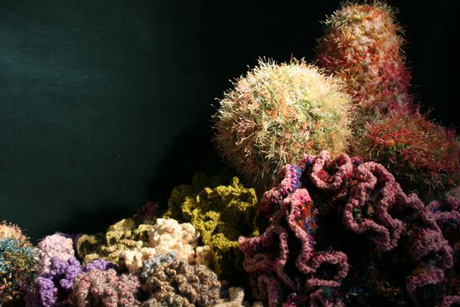
The The Institute For Figuring // Gallery has produced an exhibit called "The Hyperbolic Crochet Coral Reef" displaying images of a type of crochet that is rather unusual, as pictured here. This reef carries the attribution, "Crochet Coral and Anemone Garden" with sea slug by Marianne Midelburg. The pieces model various types of corals, and the exhibit includes information on the coral reefs that are the inspiration for the exhibit. It's hard to say exactly what the Institute is about. It is about crochet; it's about pollution and the ocean; it's about hyperbolic space, fractals, and other things quite esoteric by my standards. But this exhibit is clearly a celebration of the intersection of handicraft and higher math, science and ecology. Not at all what I was looking for when I went searching for an online exhibit to blog this week.

The exhibit consists of information pages on coral reefs, pollution, the rubbish vortex in the Pacific Ocean, and the galleries themselves, pages with thumbnails of the crochet corals that can be enlarged to show detail of the handiwork. The images in the information pages are captioned, but the gallery images are not. No additional metadata on the images is available.

The audience for this exhibit is probably a general audience, though I suppose that there probably aren't that many people interested in crochet that expresses higher math and concern for global warming, plastic pollution, and the death of coral reefs all at the same time. I certainly learned something from my visit.

Deep within Cornell University's Albert R. Mann Library website, I ran across an interesting digital book collection called The Hive and the Honeybee, which comprises 30 digitised books from the E.F. Phillips Beekeeping Collection. The thirty books selected by scholars date from 1807 - 1917, but the digitised portion of the collection grows as funds become available.


To the left of each page is a clear menu including Main, About, Search, Brouse, Contact, Help. The help includes a list of FAQs, and also lists hints for Gerneral use, searching, browsing, and other topics. In essence, this collection could be used as a library teaching tool because it provides step-by-step explanations of searching through Boolean, Proximity or Bibliographic searches. It also describes how and in what format documents or entire books can be saved and printed as PDFs. In this help section, we eventually discover that the Hive and Honeybee materials were encoded in simple SGML with a 40-element DTD that conforms to TEI Guidlines. Books can be viewed either as page pics or as OCR text, and either in single page or the entire book.


Each of the 30 books was run through OCR prior to posting, so we can search the text of each book and also see the full text alongside the page shots. That's great, except that no-one seems to have gone back to correct the OCR, as shown by the fact that the tall s and ct ligatures were not read correctly. Here's an example of what the OCR did with the 1807 book: "But although many inter*-efting peculiarities have been difcovered, they are fo much interwoven' with errors, that no fubjed has given birth to more ab-furdities." The transcription of the word subject as "fubjed" really does look "abfurd".

Navigation within a book is a little slow to load, but is fairly good. A drop-down menu of pages allows you to select a page, and it even notes which ones are illustrated. Metadata accompanying each book that can be seen by the user is limited to Author, Title, Publication Info, Print source, Subject terms, and the URL. I see two problems with this: 1. Publication Info is invariably just the name of the Mann Library, without any further call number or shelf location information for citation. 2. There is no indication of how long a book is to help the user determine how or whether to download it. The only way to determine this is to open a book and scroll down the page reference drop-down box, which can take a long time for books over 50 pages. As for viewing, the images of pages can be scaled up twice, which for printed books is usually sufficient but leaves a bit wanting for illustrataions and photgraph. A rotation tool could also be useful for anyone who does not want to print or download images that are rotated 90 degrees to fit into the book (i.e. landscape prints).

Another thing I regret is that most covers and endleaves were not photographed in the process. Much of the interesting provenance information is located on those leaves. This project (or more likely the preservation microfilm project from which the images were obtained) clearly is interested more in the book as text than book as artifact and object of cultural history.


I find it interesting that external funds were raised for this project from interested apiculturalists across the country, beekeeping clubs, and as memorials in honour of bee lovers. This system of donation is similar to the way Phillips endowed the collection in 1925, when he asked each apiculturalist to set aside one hive to generate $50 in honey which was contributed to the book fund. All of the donors for the digital version of the collection are listed on the credits page, which can be linked to from the About page. Also listed in the credits page are the experts who selected the materials, 4 site designers and developers, and 7 project staff (bibliographer, public programs administrator, preservation librarian, preservation assistant, two metadata services people and a copyright specialist).

If you have time, it's an interesting collection to browse (by author, but with 30 books, it doesn't much matter). As for me, I'm off for a piece of toast with honey now.

Textile Museum of Canada


The Textile Museum of Canada holds more than 12,000 pieces and represents over 200 countries and regions. It is one of only eight museums of it's kind in the world. The TMC Collection Online is a research tool of images and descriptions relating to thousands of works in the permanent collection. While the website states that it is ever expanding, I was unable to find a clear statement concerning the selection process of which items are to be digitized. On the left hand side of the search page they pull out "Popular Objects" but they do not indicate what "popular" references.


The TMC collection is searchable by keyword and also has an advanced search function that allows search by variety of categories including object, title, maker, local name, place made, materials, people, ID, etc. I typed in wedding and came across 56 items. You can view the retrieved items by list, list with thumbnails, or by a detailed catalog of each item.


I chose to view a wedding dress from the mid 20th century. The item view details what the object is, its local name, the place it was made, the date it was made, it's dimensions, the materials and techniques, as well as who the donor was and the objects unique ID number. Each object also has it's own narrative. The narrative of the above object (the wedding dress) is as follows:
Most garments are made from cut-and-pieced fabric by shaping a two-dimensional plane of cloth onto a three-dimensional form – the human body. The shaping is to allow for ease of movement, but the number of triangular pieces or gores that fan out the lower part of this dress goes well beyond what is needed for comfort.

Both the front and the back of the dress can be enlarged to an impressive degree, allowing a lot of the embroidery and detailing to be visible. I think that other than not providing information about their selection process, that this site is a great tool for researchers and casual visitors who are interested in textiles. It is a better visual tool than it is a resource for people to learn in-depth information about each object, but that being said, the objects appear to have been digitized well, with regard for the physical object.

Tuesday, March 20, 2007

Einstein Archive

The Einstein Archive is a digitization initiative from the California Institute of Technology and the Hebrew University of Jerusalem. It includes digitized manuscripts of personal and scientific writings and travel logs. The click through on the site is rather difficult to follow. The labels aren't very clear and the user doesn't really get a good sense of where the linked text will take them. It is similarly difficult to travel back without going through each page via the back button. After six clicks I finally reached actual material. There I found a database record chock full of metadata and finally image links. The images I viewed were available in German and English and were typed and appeared to be published works. The audience for the site could vary. Einstein is a popular figure, but many of his works would only be seriously considered by scholars. He is however, exceedingly popular so it seems that most of his published works would be widely available. The real gems of this exhibit are the travel logs and more personal items. Although, they can be a bit tricky to find.

Fixed Gear Gallery

The Fixed Gear Gallery is a labour of love created and maintained by Dennis Bean-Larson. The Gallery evolved from just that, a series of pictures of bikes emailed by users, to a bonafide resourced in the fixed gear cycling community. Fixed gear bikes are bicycles with only one gear and a fixed rear wheel (meaning you are constantly pedaling and can't coast). The simplicity of the bicycle's mechanics constrasts with the painstaking aesthetics of the enthusiast. Because the mechanical aspect of the bikes is relatively easy to handle, many cyclists who might otherwise leave bike mechanics to the pros feel confident learning how to build and repair them themselves, creating a cult of fanatics trolling eBay and local bike shops for the perfect parks. It's an interesting intersection of sport culture, environmentalism, consumerism, and popular culture, and it's on display at the Fixed Gear Gallery.

Bean-Larson has accepted submissions for the gallery since 2001. That year, 51 users submitted images of their bikes. In 2006, there were 1,458 additions. The images are available as links in a tabular format, creating something of an awkward navigational experience for the user. Additionally, the site accepts articles, interviews, and how-tos from readers, and these are located similarly awkwardly, to the left of the image links. There is no search function available, and images are identified by number. Clicking on a link (usually the name of the user and the type of bike) opens a new window with the image as well as the only available "metadata", the text of the email that acompanied the image attachments we're now viewing. This format is obviously quick and easy for the web builder- there are no editorial decisions made- but we're able to view the sender's email and, depending on the nature of the email client, personal and/ or business information along with the date and timestamp information. This could create privacy issues in the long term.

In terms of submission guidelines, the site specifies that submissions should be attached files, jpegs only, with a total email size of no larger than 5MB. There are no further specifications, and there is no control over photo quality. The photos could be digital images or scans.

The site exists primarily as a resource and point of connection, and while I doubt preservation is a high priority, there is a great deal of information here that could be lost. I'm questioning where backups are, if there are any, etc. To me, this is an example of a very low-tech site that is hugely important to a niche community and the only one of its kind, but could easily become difficult to maintain. There is an archived version of the site as it appeared in 2001 and 2002 here.
Harry Ransom Center Online Exhibitions
The First Photograph


The Harry Ransom Center's permanant online exhibition of the First Photograph documents the creation, rediscovery, and conservation of the first image captured by Joseph Nicéphore Niépce in 1826. The image, a scene from an upstairs window, was the first to be successfully captured on a polished pewter plate sensitised with bitumen of Judea which hardens on exposure to light. After 8-10 hours of exposure, he had managed to produce the first permanant photograph from nature.

The exhibit has some good things going for it as an information source. There is an easy-to-navigate contents bar across the top of each of the 8 pages in the exhibition. The final page is a list of credits, listing the people who worked on the text, took photographs, and owners of non-HRC material. The site also explains why the real photograph object is exhibited the way it is in the HRC, how the case was constructed and other useful details. The chronology page gives readers an extended view to outline the history and provenance of the photograph from the birth of JNN to 1963. The conservation and preservation page is perhaps the most interesting, and it certainly has the best illustrations and the most technical information.

While the site serves its didactic purpose, it has severe drawbacks from an exhibition standpoint. This is due in part to the text-heavy layout (I used the word 'readers' above on purpose). Many of the images are far too small for the viewer to gain anything of substance from them. The credit section mentions no technical information on how the images were taken, how anyone else could cite or call them up in the reading room, or what resolution etc. was used in digitising the material.

Because this exhibition is just that, it is not just to condemn it for the lack of specification of technical matters, but I believe the HRC should concentrate on improving the general standard of their online exhibits. This one was put together a few years ago, and it really does show. Hopefully it can get the same update that the Beckett and Morris exhibits are currently undergoing.

Monday, March 19, 2007

Bill Viola: The Passions (Getty Exhibition)

This website documents Bill Viola's exhibition The Passions which was organized by the J. Paul Getty Museum. The exhibition was shown at the J. Paul Getty Museum, the National Gallery in London, Fundacio "laCaixa" in Madrid, and the National Gallery of Australia in Canberra during 2003.

Collection Principles
The videos, images, essays and catalogue excerpts displayed on the site are intended to give the user an understanding of the fundamentals that underlie Bill Viola's work. Because The Passions is a collection of installation works, great care has been taken on the part of the Getty to educate the user about the effects of exhibition spatial design, image format and size, and video speed in a physical exhibition.

Object Characteristics and Metadata
The website presents five video installations from The Passions exhibition that are explored in depth: Emergence, Silent Mountain, The Locked Garden, The Quintet of the Astonished, and Six Heads. Each work has its own page. The page consists of a thumbnail still image with metadata, interactive written excerpts and video clips or larger still images. The metadata is fairly standard for artworks. It includes title, date, medium, dimensions of work and can also include information about the installation space or about the commissioning of the work if applicable. The excerpts address issues meant to help the viewer better understand Viola's motivations. Topics associated with each video installation include: connections to past art, themes in art, the making of the video, artist's notebook entries, influences from past art, and a place for viewers to post their reactions to the work. Video excerpts from some of the works are available for streaming. Sometimes, the viewer is limited to stills from the original video.

Under "the Exhibition" there are still images from more works in The Passions exhibition. These still images allow the viewer to zoom in for better detail. The images are identified with minimal metadata and strung together with a brief essay by John Walsh, Curator and Director Emeritus of the J. Paul Getty Museum. To supplement these images, there are links to the exhibition checklist and credits and to Mark Kidel's video documentary "Bill Viola and Emergence." The checklist and credits include all individuals involved with the works shown in the physical exhibitions (including the actors and production staff used by Viola) and all individuals involved with the website creation.

Audience
Although Bill Viola has his own website, very little of his visual work is available to the public in an easily accessible format. There are very few videos that can be purchased, even for exclusively educational purposes, of his more recent works. As such, the access that is provided by this website is quite remarkable to individuals interested in Viola's work. It would also be a good site for individuals interested in past Getty exhibitions or individuals interested in how contemporary artists interact with Medieval and Renaissance art.

The Lester S. Levy Collection of Sheet Music

The Lester S. Levy Collection of Sheet Music is a collection at the Milton S. Eisenhower Library at the John Hopkins Univeristy. The collection itself has over 29,000 pieces of music and is centered around American music between the years 1780-1960. The music itself was given to John Hopkins as a gift, in which he had created his own cateloguing system and as such, everything was cross indexed when it arrived at the university. Levy wanted to help to increase appreciation in music through his collection.

When first accessing the site, the user is able to select either the browse feature if they just want to browse, or the search feature if the user is only wanting to search whats available. Each piece that is located presents a thumbnail of the scanned sheet, as well as the ability to enlarge the image. Below with each image includes information about the composer, lyricist, publisher, title, instrumentation, the first and last line of the piece, the subject and the call number.

Each of the pieces are arranged by subject, which are then seperated into seperate boxes. In this way, if a user does travel to John Hopkins, the process in locating the piece they are searching for would be realitively easy. Because Levy had is own subject headings, these subject headings are also available on the website to clarify what to what he is referring to.

Another interesting note to this site is an explination as to why some songs are not available for viewing. The project will not put up music that is published after 1923 because it is not in public domain. A text is available, but the music itself is not available. For music published before 1923, the library has a note stating they are willing to make photocopies for a small fee.

The images themselves are a bit blurry and make it difficult to make out any text or notes on the music sheets themselves. Apparently, this only happens on some computers, while on others it is not a problem. It is a problem they are working on. They also state quite clearly that the resolution is not great, but this is all that is available as to any technical aspects of the online collection.

Their selection process was simple- there was none. Everything that was in Levy's collection is shown.

This collection seems to available for general users as well as researchers. The site states that researchers and especially musicologists were using his collection even before it came to the university, so its current location makes it much simplier to access.

Overall, I think this collection is well done. Despite the poor resolution, it seems as though the library is willing to do what is necessary to accomodate their users within the legal bounds.